FAQs


General information

How can I buy your products?

You can fill the available form in Contact | Metrohm DropSens (metrohm-dropsens.com) or directly send us an email to sales.dropsens@metrohm.com  and we will put you in contact with your closest Metrohm DropSens representative .


How can I contact the distributor in my country?

Find the information about your closest distributor in the Contact | Metrohm DropSens (metrohm-dropsens.com) section also you can contact us at info.dropsens@metrohm.com or sales.dropsens@metrohm.com and we will put you in contact with the Product Electrochemistry Manager in each area to support you. 

How can I pay for my order?

Please check the payment terms with your local Metrohm representative. 

How long will it take me to receive  my products?

You should check the delivery times with your local Metrohm representative since shipping times may vary depending on stock availability on the country  and custom processes. 

How can I contact technical support?

Please fill the Technical Support & Service | Metrohm DropSens (metrohm-dropsens.com) form and your nearest Metrohm DropSens technical representative will contact you as soon as possible. You can also write us directly to info.dropsens@metrohm.com or you can call us on +34 985277685.


What warranty is applied to Metrohm DropSens products?

All our instruments are covered with a 3 year warranty period. The rest of our catalogue products are considered consumables and therefore are not subjet to any specific warranty period. Nevertheless, we would always evaluate each case and offer you with support to help you solve any problem that may arise. 

Is Metrohm DropSens an ISO certified Company?

DropSens is certified according to the ISO 9001 and ISO 13485 for the "manufacturing of sensors for medical devices" standards. You can check the quality system section in our website to find out more information Metrohm DropSens | Quality System (metrohm-dropsens.com)

I need a product that is not in the catalogue,  how should I proceed?

We have the capability of manufacturing customized products (electrodes, accessories, instruments ...) attending to your specific requirements. Please send us an email to info.dropsens@metrohm.com with a brief information on your needs and we will get in contact with you as soon as possible to evaluate your request. 

Do  you manufacture OEM products with private lavelling?

We  are an experienced supplier of  electrochemical OEM solutions. Please contact us at info.dropsens@metrohm.com and we will schedule a meeting to further discuss about your needs. 


Electrodes

How do I use Screen-Printed Electrodes (SPEs)?

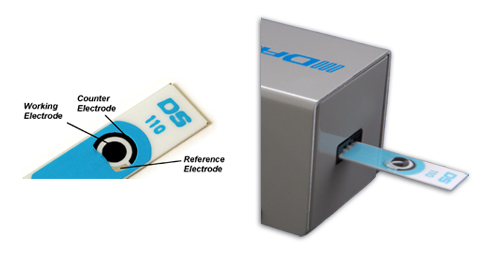
It is very easy. With the aid of a micropipette just place a drop of 60 µL making sure you cover the three electrode system (working, auxiliary and reference electrode). You can also immerse the electrode into solution. Just make sure that the 3 electrode system is in contact with your solution.


Which electrode model is recommended for my application?

Take a look at the "Publications" section in our website and, with the help of filters and the search engines, you may find publications from other Researchers that are using our products in a similar application than yours. This information may be a useful as a guidance on material or design of SPE could be suitable. 

Of course,  you can contact us anytime and we may provide you with related advice. Still, you have the complete knowledge in your specific research and testing the SPEs would be the best way to find out which reference suits you better.

Should I pretreat the electrodes?

Electrodes are ready to be used and no general pretreatment protocol is established. With screen-printed electrodes you avoid tedious polishing steps of conventional solid electrodes before performing a measurement.

Still, some researchers apply electrochemical pretreatments for specific applications. For example, the typical treatment of gold electrodes is preforming successive cycles in sulphuric acid (0.1M) between 0 and 1.6V at s.r. 100mV/s.

You can check the "Publications" section in our website to find out what other users of these references usually do.

Single use electrodes: can I use them more than one time?

SPEs are designed as single use platforms for the development of different (bio) sensors. We recommend and guarantee their  best performance when used as disposable. The possibility of re-using the electrodes and if so, how many times, really depends on your specific analysis protocol and should be then decided by each researcher as part of their optimization process.  


What range of pH solutions can be used with screen-printed electrodes?

SPEs can be used in acid, neutral and basic media as any other conventional solid electrode.

What electrode substrates do you have available?

Most of catalogue electrodes are manufactured over ceramic (alumina). We also work with white and transparent plastic (PET), with PCB (FR4) and glass (pyrex).

Manufacturing in other materials can be evaluated under request as a customized product.

Could you manufacture electrodes with my own design?

Yes, we have the capability of customizing electrodes under your requirements. You just need to provide us with all details regarding dimensions and materials and send us a rough sketch of your desing for evaluation. Based on your request we will then provide you with a scalable price.  You can write us to info.dropsens@metrohm.com and we will provide you with a questionnaire to easily fill all the details that are needed.

Which are the differences between gold electrodes AT and BT?

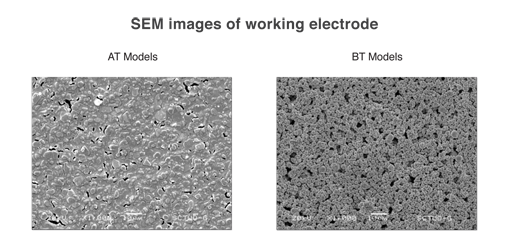
The difference between AT and BT electrodes is that they are made with different kinds of gold screen-printing inks. AT ink is cured with a high temperature process (around 900ºC) whereas BT uses a low temperature process (around 150ºC). In the SEM micrographs of both models' surfaces below, it can be noticed that BT models show a rougher surface due to the low temperature treatment.

SEM

We have these two kinds of gold in order to offer a wider electrochemical behaviour to researchers when it comes to gold electrodes. In other words, AT and BT models can show different or similar behaviour depending on the particular experiment i.e. they may have different or similar electrochemical properties depending on the redox system used. There are not defined criteria to describe the properties of each model because these properties depend on the sensor developed, on the electrodes and on the redox molecule tested. For example, ferricyanide shows better electron transfer on AT electrodes than on BT electrodes; also, in a general way we can say that AT models sometimes show better repeatability results, but customers often select BT models to develop biosensors on them. For these reasons, the best way to start working with these electrodes could be testing them and compare their characteristics for the specific application.

In order to find out which reference is more suitable to your concrete application, you can check the "Publication" section in our website or you can also acquire a box of ref. DRP-AUMIX, including a mix of gold electrodes of high and low temperature. 


Can I sterilize electrodes?

Yes, we have tested that autoclave during 5 min and 120ºC does not affect SPE performance.

Which temperature can withstand Metrohm DropSens electrodes?

It mostly depends on the substrate and the presence of dielectric (green polymer):

  • Ceramic SPEs with dielectric can resist up to around 100 ºC  whereas ceramic SPEs without dielectric (such as ref. IDEAU200) can resist up to 800 ºC. 
  • Plastic substrate electrodes can resist up to 80 ºC 
  • Glass substrate electrodes can resist up to 450-500 ºC


Are SPEs suitable to be used with organic solvents?

SPEs are meant to be used with aqueous solutions however they resist certain organic solvents under concrete conditions. If you plan to use our SPEs with organic solvents contact us and we will inform you on the tests we have carried out.

Which are the main differences between an Ag pseudoreference electrode of a SPE and a standard Ag/AgCl reference electrode?

Metrohm DropSens' standard screen-printed electrodes use a silver pseudoreference electrode. There is a shift of -131mV when compared to classical Ag/AgCl reference electrode.

If you are interested in working with an Ag/AgCl pseudoreference electrode you have available in our catalogue refs DRP-11L and DRP-C11L.

Any of our catalogue models or any design can be manufactured as customized with Ag/AgCl ink.

Can I use an external reference electrode instead of screen-printed reference electrode?

Yes, there isn't any inconvenience in using an external reference electrode instead of the printed one. There is also the option to custom your electrodes without screen- printing reference electrode.

In flow injection analysis (FIA), should I change the screen-printed electrode after each measurement?

It depends on the analysis you are performing, but given the functioning of a FIA system most of the times there is no need to change the electrode and you can reuse them. Each process should be optimized for your concrete application. 


What is the thickness of the working electrode in the thick film electrodes?


The metal is deposited over the ceramic substrate by PVD and a thin layer of 1μm pure metal is obtained. Besides this, the roughness of these electrodes corresponds to the roughness of the alumina substrate, it means Ra = 1 μm.

Which is the thickness of the G-IDE electrode models?

Interdigitated electrodes over glass substrates are manufactured by photolithography. The layers obtained are within the range from 150 to 200 nm.

What is the adhesion layer in the IDEs electrodes over glass substrate made of?

In order to get a better adhesion of gold or platinum over glass substrate, a thin layer of titanium is deposited before sputtering with gold or platinum.

Which are the references recommended for the formation of self-assembled monolayers (SAMs)?

There are many possibilities including gold and silver electrodes (ref. DRP-220AT, 220BT, 250AT, 250BT, C013, 013). Another possibility could be to use carbon modified electrodes with gold or silver nanoparticles  (ref. DRP110GNP, 110AGNP). 

You may find a list of related articles on this application on the "Publications" section of this webpage. 

I am interested in immobilising a biotinylated antibody in the surface of a screen- printed electrode what SPE reference model is recommended?

Streptavidin or ExtrAvidin modified electrodes are the most convenient ones for immobilization of large amount of biotinlylated molecules. 

Why are useful the streptavidin modified screen-printed electrodes?

Streptavidin is a protein purified from Streptomyces avidinii and it is characterized by an extraordinarily high affinity for biotin. Streptavidin is used in biotechnology due to the strongest non-covalent interaction to biotin.

Are Streptavidin electrodes stable at room temperature?

These electrodes are stable at room temperature. However, we recommend storing it at 2-8oC in a fridge where the temperature is well controlled. 

Can I perform impedance measurements with Metrohm DropSens electrodes?

You could work with most of available Metrohm DropSens electrodes, depending on your specific needs. Our publication page includes numerous reference papers that will help on your research.

I am working in the development of a high-throughput screening test; do you have any product suitable for such kind of experiments?

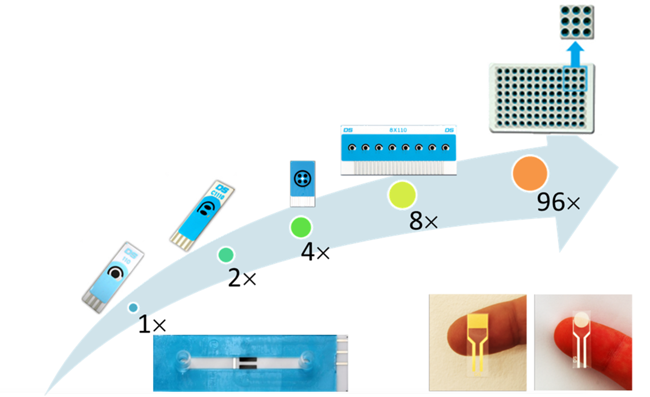
High-throughoutput tests can be performed in batch or in flow using a wide range of products available at Metrohm DropSens. You can select from a wide range of screen-printed 96X electrochemical ELISA plates or 8X electrode arrays, which can be a good option to perform multiplex assays. Individual electrodes used with specific multichannel connectors and instruments are also suitable for multiplex analysis.


On the other side, BIACELL or FIASYSTEM are also suitable solutions for performing high-throughput tests.

Is it possible to use ref. 96X110 or any other of these references for UV or fluorescence measurements?

The bottom of the well-plate is a PCB substrate while the wells are defined by standard black polymer used in ELISA plates for fluorescence. Depending on your system, they can be compatible just that PCB substrate do not interfere with your signal.

Which are the most useful Metrohm DropSens electrodes for spectroelectrochemical transmission experiments?

For transmission analysis while performing an electrochemical test we recommend transparent working electrodes references PEDOT10, COTE10, ITO10 or AUTR10. The different available materials, PEDOT, Carbon, Indium Tin Oxide and transparent Gold are perfect for getting a good transmission signal. You can check all the references acquiring the mix of OTE, OTEMIX.

Which kind of electrodes are thin-layer flow-cell integrated screen-printed electrodes (TLFCL family)?

These Screen-printed electrodes have integrated a one-channel flow-cell an easy control of the sample volume in batch mode and also in flow injection analysis.

Is there a limitation on maximum flow-rates when working with TLFCL SPEs?

The cover is highly stable and high flow rates can be achieved. For example, 4 mL/min could be used in a measurement. However the optimal flow rate should be checked as it depends on your specific experiment.

Why are microelectrodes attractive for analytical applications?

Because they show a specific behaviour due to nonlinear diffusion and the observed steady-state currents- which allow the study of electrochemical reactions in short time - yield in higher currents.

Which is the collection efficiency in generator/collector sensors when using G-IDE222 or G-IDE555 references?

It is the ratio of currents at the generator and collector electrodes, when using G-IDE222 and G-IDE555 as generator/collector sensor.

What is the thickness of the PEDOT layer in the electrodes P10?

The screen-printed PEDOT layer has a thickness of 3 +/- 1 μm.

Interdigitated electrodes are usually used for conductivity measurements. Which are the Kcell of Metrohm DropSens Interdigitated Electrodes (IDEs)?

You can check here information for each reference.

Portable Potentiostats & Galvanostats

How can I access to the user manual of my instrument?

User manual is copied in your computer during software installation. It can be found in the same folder where you have installed Metrohm DropSens software. If you are not able to find it, please ask the customer service and they will kindly guide you.

How can I install the instruments?

The setup wizard included in any Metrohm DropSens software will guide you through the installation process. All our Softwares are Windows based compatible with current operating systems and very intuitive. It is really easy! 

Do not connect the device to your computer before the software and drivers are installed.

Can I update my DropView Sofware? 

Users of DropSens' instruments are entitled to receive software updates free of charge, for an unlimited period of time.

Is there a tutorial for working with DropView softwares?

DropView softwares are very user friendly and have very intuitive interfaces; each software includes a manual of use. Still, we will be pleased to help you and arrange a webmeeting to show you the software performance.

What are the computer or laptop requirements for using Metrohm DropSens potentiostats?

Screen resolution of 1024 x 768 minimum and 1280 x 1024 advised.

64-bit (x64) processor.

8 GB RAM minimum and 16 GB advised.

Is DropView software compatible with all kind of tablets?

Only tablets with Windows operative system can run DropView Software.

Can I use Metrohm DropSens equipments with conventional electrodes?

Of course! In fact all Metrohm DropSens equipments include in their set a cable connector from the equipment to conventional electrodes via banana and crocodile clips.

I have seen in the software the option "Peripheral Configuration", what does it mean?

The Digital and Analog Inputs/Outputs are configured with this menu; the displayed window allows you to enable or not the desired Programmable I/O (PIO) pins.

I would like to perform battery Charge/Discharge experiments, is it possible with DropView 8400?

Yes, it is very easy with "Manual Control Script”, which makes a current Charge/Discharge potential profile with cutoff values. DropView 8400 software has "Manual Control Script" option with different available commands, for this and other applications.

Do Metrohm DropSens instruments have floating mode option?

Floating mode can be archieved when working with battery and via wireless connection to the computer; therefore, all the instruments that have wireless connection option are suitable to work under this condition. 

In case you need to run long experiments in floating mode you can make use of ref. USBFLOATING cable to place your instrument in floating mode (Suitable forμStat 300 μStat 400 μStat-i 400 μStat-i 400s μStat ECL).

μStat-i MultiX can be configured optionally with floating channels.

Which is the maximum number of points per experiment that can be saved in DropView software?

It is 65000 data points.

Can Metrohm DropSens instruments be connected to an external system such as a chromatography instrument?

Yes, by making use of the external inputs/outputs and with the suitable cable CDIO cable. Contact us at info.dropsens@metrohm.com and we will help you configuring your set-up. 

How can I calculate the Polarization Resistance with DropView 8400?

The software calculates it directly after clicking on corrosion analysis tool and using the fit option – using tafel slope in the analysis tool.

In which equation is based the Fit analysis tool in DropView 8400?

It is based on Butler-Volmer equation.

Can I perform corrosion measurements with Metrohm DropSens instruments?

DropView 8400 allows to perform corrosion analysis through the data obtained by LSV, OCP and CV. Tafel and fitting analysis can be easily performed and LPR technique is also available.

Why is the wireless connection useful in a potentiostat?

Wireless connection in our devices is very useful for wireless data transfer and remote control. You can place the instrument inside a glove-box, optical-box… while you control it from your computer.

Which are the differences between DropStat and DropStat Plus readers and other potentiostats?

Dropstat and DropStat Plus are readers that would be of interest once you have finalized the development and optimization of your sensor. They will be programmed according to your specifications and they will show in the screen the concentration of the analyte for which the electrochemical sensor has been developed. They are ideal as a proof of concept for the finalization of a project but they are mainly designed to be private labelled for their manufacturing in high amount of units as an OEM product for future commercialization. 

If you are still running a research and your sensor is not optimized then you may run your research with one of our standard potentiostats. 

 I am interested in a DropStat or a DropStat Plus, which information is needed for its programming?

Please contact us at info.dropsens@metrohm.com and we will provide you with a questionnaire including all data that is required for you to fill. The main information required is electrochemical technique parameters, calibration curve and example of an obtained curve. 

What type of information can I see in the screen of a DropStat or DropStat Plus?

DropStat and DropStat Plus are customized readers suitable to provide final concentration values for an already develped sensor. Based on the details provided and associated to your calibration curve you can obtain in the screen values related to peak height, peak position, peak width, peak area, current or concentration. 

What are the main differences between portable potentiostats without impedance µSTAT200, µSTAT300 and µSTAT400?

 Please, check in the chart below some of the main differences between these instruments.

  µSTAT200 µSTAT300 µSTAT400
Power USB Li-ion Battery/USB/DC
Charge adaptator
Li-ion Battery/USB/DC
Charge adaptator
PC Interface USB Wireless Connection/USB Wireless Connection/USB
Operating modes Bipotentiostat (same potential applied to each WE).
Potentiostat
Bipotentiostat, Potentiostat Bipotentiostat, Potentiostat, Galvanostat
Number of channels 2 WE sharing AUX and REF 2 WE sharing AUX and REF 2 WE sharing AUX and REF
DC-Potential Range ±2V ±2V ±4V
Current Ranges ±1nA to ±100µA
(6 ranges)
±1nA to ±1mA
(7 ranges)
±1nA to ±10mA
(8 ranges)
Max. Measurable current ±200 µA ±3 mA ±40 mA
Available Techniques Total:6 Total: 10 Total:22
 
· Voltammetric: LSV, CV, SWV, DPV.
· Amperometric: AD, PAD.
· Voltammetric: LSV, CV, SWV, DPV, NPV, NPDV, ACV.
· Amperometric: AD, PAD, MAD.
· Voltammetric: LSV, CV, SWV, DPV, NPV, NPDV, ACV, LPR.
· Amperometric: AD, PAD, MAD, FA, FRA, COUL.
· Potentiometric: LSP, CP, PD, FP, ZCP, PSA (G/F), MPD.
· LSV+AD; CV+AD.
Software DropView 200 DropView 8400 DropView 8400

Please, do not hesitate to contact us. We will help you and recommend the most suitable instrument according to your requirements and needs.

What are the main differences between your available multichannel instruments?

Portable multichannel instruments without EIS : µStat 8000/P  (8 channels) and  µStat 4000/P (4 channels):

- Independent channels that allow independent configuration but should run simultaneously

- USB and battery powered and wireless connection

- Potentiostatic multichannel configuration with up to 4 or 8 working electrodes sharing 1 auxiliary and 1 reference


Multichannel instruments with EIS : µStat Multi4 (4 channels), µStat Multi8 (8 channels), µStat Multi12 (12 channels) and µStat Multi16 (16 channels):

- Totally independent channels that allow independent configuration and also they can run independently

- Upgradable with more channels at any time up to 16

- Remote connection cabapility allowing that various users are connected at the same tieme to the same instrument

- Potentiostatic and galvanostatic multichannel configuration with up to 4,8,12 or 16 working electrodes sharing 1 auxiliary and 1 reference

- Galvanic isolated channels upon request

I would like to work with  with several working electrodes sharing 1 auxiliary and 1 refrence electrode, what models do you recommend?


Portable multichannel instruments without EIS : µStat 8000/P  (8 channels) and  µStat 4000/P (4 channels):

You may work with 4 WE or up to 8 WE depending on your model

Available techniques in multichannel configuration (only potentiostatic): LSV, CV, SWV, DPV, NPV, NDPV, AD, ZRA, FA, PAD and COUL.


Multichannel instruments with EIS : µStat Multi4 (4 channels), µStat Multi8 (8 channels), µStat Multi12 (12 channels) and µStat Multi16 (16 channels):

You may work with 4 WE,8 WE, 12 WE or up to 16 WE depending on your model


Available techniques in multichannel configuration (potentiostatic and galvanostatic): LSV, CV, AD, COUL, LSP,CP, PD and OCP

Spectroelectrochemical instruments & accessories

I have my own optical cell and fibers. Are they compatible with SPELEC instruments?

Any optical cell is suitable to be used with SPELEC instruments.  Regarding fibers, the connectors in the SPELEC are standard SMA 905 so any fiber with this connection will also be suitable. 

Please bear in mind that nevertheless you have available a wide range of spectroelectrochemical accessories including cells and fibers at Metrohm DropSens  

Can I use the components of the SPELEC instruments independently? 

SPELEC instruments are designed for performing spectroelectrochemical measurements and you can make the most of it combining both techniques for operando/time resolved measurements. Still you can use all its components independently as a potentiostat/galvanostat, light source or spectrometer. 


Do you offer SERS substrates for Raman spectroelectrochemistry?

As the Raman scattering is inherently low and not useful for low-concentrated samples, the SERS technique is being widely employed for different applications. This technique is based on the enhancement of Raman signals by the interaction between molecules and metallic surfaces. Metal screen-printed electrodes are promising SERS substrates because they are available in different materials such as gold, silver, or metal nanoparticles... They are readily available, cost-effective, disposable, and only need a low sample volume. Some of the recommended SPEs could be C013 model with silver WE or 220BT with low temperature curing gold. 

Which is the distance between the RAMANPROBE and the electrode surface?

RAMANPROBE has a focal distance of 7.5 mm, allowing us to adapt it to different cells and setups. RAMANCELL is designed according to this value, but it is provided with different spacers to optimize the distance between the probe and the electrode surface, for an easy improvement of the Raman signal. Other RAMANPROBE with different specifications can be provided under request.


You have available different SPELECRAMAN models (785,638 and 532 nm), can I combine more than one laser in the same SPELECRAMAN instrument?

This is not possible as the laser has to run in combination with a detector suitable for each wavelength. 


How should I clean the RAMANPROBE window?

RAMANPROBE is a non-immersion probe, which must be gently cleaned with a soft paper and ethanol when it  Immersion RAMANPROBE can be provided under request.

There is an option for smoothing the spectra, how it works?

You can have a cleanest signal with the option of easily applying a Savitzky- Golay smoothing.

Can I correct the baseline in Raman spectra?

“Auto baseline” is an interesting tool implemented in DropView SPELEC software that corrects automatically the background signal of whole Raman spectra.

Accessories

I cannot find the cell or connector I need for my application, can you customize them?

Yes, we have the capability of customizing also accessories, please send us an email to info.dropsens@metrohm.com for evaluating the feasibility of your requirement. 

Can I use my potentiostat with CONNECTOR96X?

CONNECTOR96X is designed to be used, in combination with multichannel µStat 8000/P instrument and SYNCONN96X with DIOC8000SYNC96 cable, as a high throughput screening platform being able to read the 96 wells of a 96X format SPEs.

Still CONNECTOR96X is a universal connector that will allow you to connect any instrument via 2 mm banana cables. In case you may want to use your instrument also in combination with the SYNCONN96X to automatize the reading please make sure your instrument has available the possibility of script programming and contact us so we can custom manufacture a specific DIO cable.  


If I want to run flow-injection analysis experiments, what components should I order? 

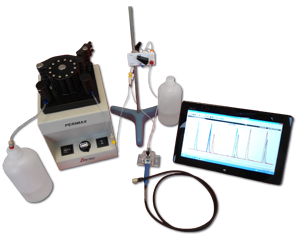
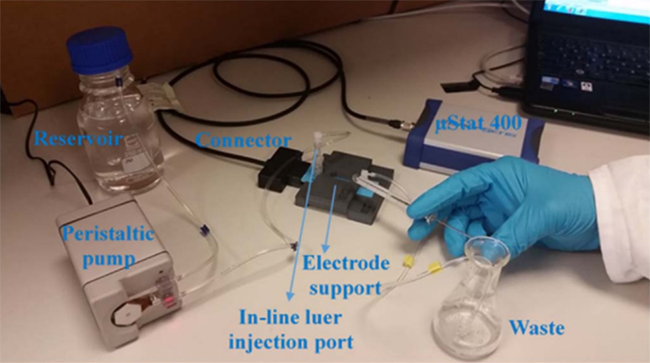
The basic components of a FIA system are: a pump, an injection valve, a flow- cell and a recorder which registers the FIA signal. There are many possible combinations an you can find a complete set up ref. FIAEC to be combined with any Metrohm DropSens potentiostat  or the individual components in our catalogue.

Metrohm DropSens FIEAC

Can I use my own peristaltic pump with the flow-cell for screen-printed electrodes ref.FLWCL?

Yes,  our flow-cell is provided with suitable flow-fittings to connect it to standard tubes from flow systems.

I am interested in flow-injection analysis but I need an easy-to-use injection valve and electrode replacement, is there anything available at Metrohm DropSens?

Any Metrohm DropSens' flow-cells allow an easy electrode replacement, while the Metrohm DropSens injection valve (ref. VALVE) allows a high precision control of the volume injected.

Metrohm DropSens - FLWCL

TLFCL electrodes with their associated flow-fittings and inlineport part are also an easy-to-use solution.

Metrohm DropSens - FLWCL

How BIA works?

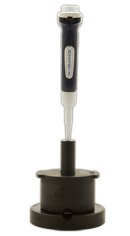
The BIASPE02 or BIASPE10 are batch systems that work as a tube-less FIA system, allowing to perform automatic injections through a programmable electronic micropipette.

Is there any difference between BIACELL and CELL?

BIACELL is designed to perform Batch Injection Analysis where you use the micropippete to inject the analyte in the cell automatically simulating the functioning of a tubeless FIA System. The CELL is used to work only in batch analysis.

Metrohm DropSens - BIASPE02            Metrohm DropSens - CELL

Which is the distance between the surface of the SPE's Working Electrode and the tip of micropippete in the BIACELL?

Once you place the micropipette inside the cell, the distance is just 2 mm.

What is the product MEMB designed for?

It is design to perform analysis with smaller volumes and covering the three electrode system (about 15 μL). It is a mesh consisting of monofilament fabric of polyamide that fits perfectly on SPEs electrochemical cell.

What is the volume and flow-rate in the flow cell, DRP-FLWCL?

The volume of the electrochemical cell delimited by an O-ring in the Flow cell is 8µl.

The FLWCL has been tested with up to flow rates of 6 mL/min.


What products do you have for magnetic based assays?

We have magnet holders for screen printed electrodes, magnetic flow cell and magnetic nanomaterials such as Ni Nanowires.

Which electrode connectors should I use between the screen-printed electrodes and any kind of potentiostat?

Which electrode connectors should I use for the screen-printed electrodes? You can either work by dropcasting over the SPE or by immersing the SPE into solution:

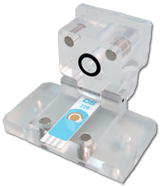
1. With the aid of a micropipette just place a drop of 40-50 µL, covering the three electrodes (counter, reference and working) like in the attached image. For this purpose, you can use the DSC connector (see image below).

DropSens

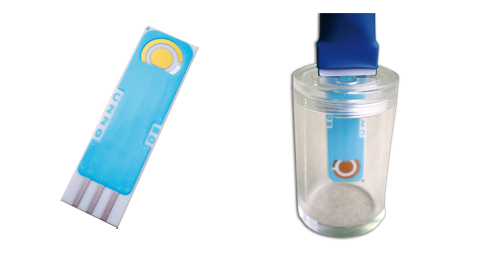
2. For working in solution you can use the CELL (picture below) with a volume of 5-8 ml covering the three electrode system in combination with cable CAST (when using a DropSens potentiostat) or cable CAC (when using any other equipment).

DropSens

For this configuration we recommend you to use DropSens work in solution SPEs with the electrochemical cell closer to the end of the strip (i.e C110, C220…etc).

How does ref. MAGNETOECL works?

Two permanent neodymium magnets allow a perpendicular or parallel magnetic field to the gravity force. Placing the electrochemical cell in between the two magnets and adjusting the distance between them a magnetic field between 0 T and 1 T is obtained.

Which is the magnetohydrodynamic (MHD) effect?

The magnetic fields induce currents in moving fluids, the fluid is polarized and a change in the magnetic field is produced. When a magnetic field is applied in an electrochemical cell, perpendicular to the electrical current, then a dynamic effect in the solution is induced as well.

Nanomaterials & Electrochemistry reagents

Is there any Nanomaterial offered by Metrohm DropSens which has magnetic properties?

Nickel Nanowires (ref. NINW) and Nickel-Streptavidin Nanowires (ref. NINW-STR).

What is graphene?

It is an allotrope of carbon in the structure of a plane of sp2 bonded atoms. A Single layer of carbon atoms that are bonded together in a hexagonal honeycomb lattice.

What is graphene oxide?

Graphene oxide is considered a precursor of graphene or a graphene material itself, as it is a graphene functionalized with oxygen groups. It is characterized for being less conductive than graphene.

Which carbon nanomaterials can be obtained from DropSens?

Carbon nanofibres, carbon nanotubes, mesoporous carbon, graphene and graphene oxide. Some of them are offer in solid but also in solution. Check the "Nanomaterials and reagents " section in our website to find out more!

What Nanoparticles and Nanowires do you commercialize?

Au, Pt and Pd nanoparticles; Pd, Pt, Ag, Pt-Au-Ni, Ni and streptatividin coated nickel nanowires are available at DropSens.

Do you commercialize Quantum Dots?

Yes, we commercialize CdSe/ZnS Core Shell Quantum Dots and CdSe Core Quantum Dots with a variety of emission wavelength ranging from 550 nm to 625 nm.

Besides these QDs soluble in organic solvent, now are available also Quantum Dots soluble in aqueous solution and also modified with streptavidin. 

What is the use of enzymatic substrates?

DropSens provides enzymatic substrates of Alkaline Phosphatase. After their hydrolysis they generate electrochemically active products such as p-aminophenol from p-aminophenyl phosphate, hydroquinone from hydroquinone diphospate and paracetamol from phosphorilated paracetamol.

High sensitivity can be achieved thanks to this electrochemically active products. Check our publications section for more info.